About Django
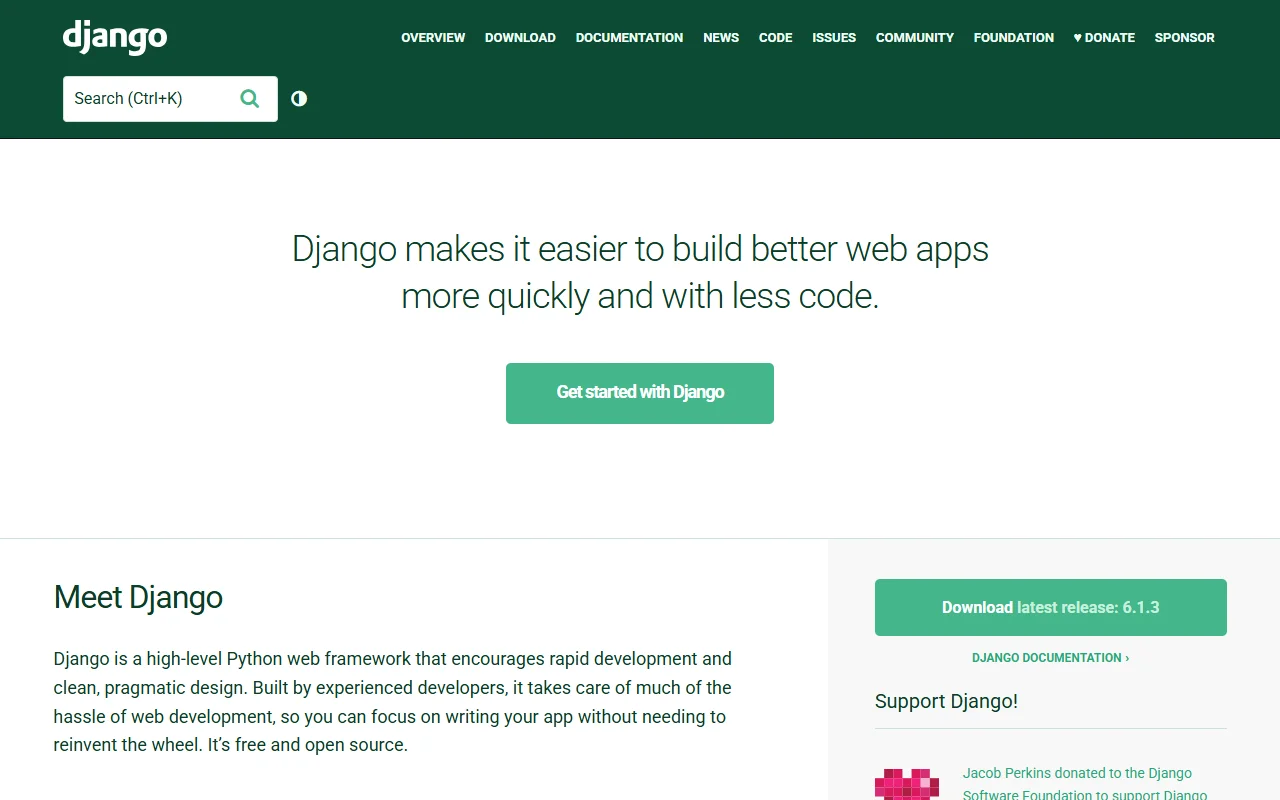
Django is a high-level web framework for Python. It helps you build database-driven websites and apps quickly, with much of the common plumbing already done.
What it does
Django gives you the parts most web projects need: URL routing, a database layer, forms, templates, user accounts and an admin interface. You describe your data as Python classes, and Django turns them into database tables through migrations. Its built-in protections guard against many common security mistakes, so you do not have to write each defense yourself.
Key features
- Object-relational mapper for working with databases
- Automatic admin interface for managing records
- Template system for rendering HTML pages
- Built-in internationalization support
- Protections against many common security mistakes
Who it's for
Python developers who want a dependable framework for content sites, internal tools, member portals or e-commerce backends. Teams that value a long-running project with good documentation and a clear structure will find it a good fit.
Pricing and good to know
Django is free and open source under a BSD license. It runs on servers with Python installed and needs a database such as PostgreSQL or SQLite. It is a full framework with its own conventions, so it is a bigger commitment than a small library.
Highlights
- Map Python classes to database tables
- Manage records with a generated admin interface
- Render HTML pages with a template system
- Support multiple languages in one site
- Guard against many common security mistakes