
About Apache Cassandra
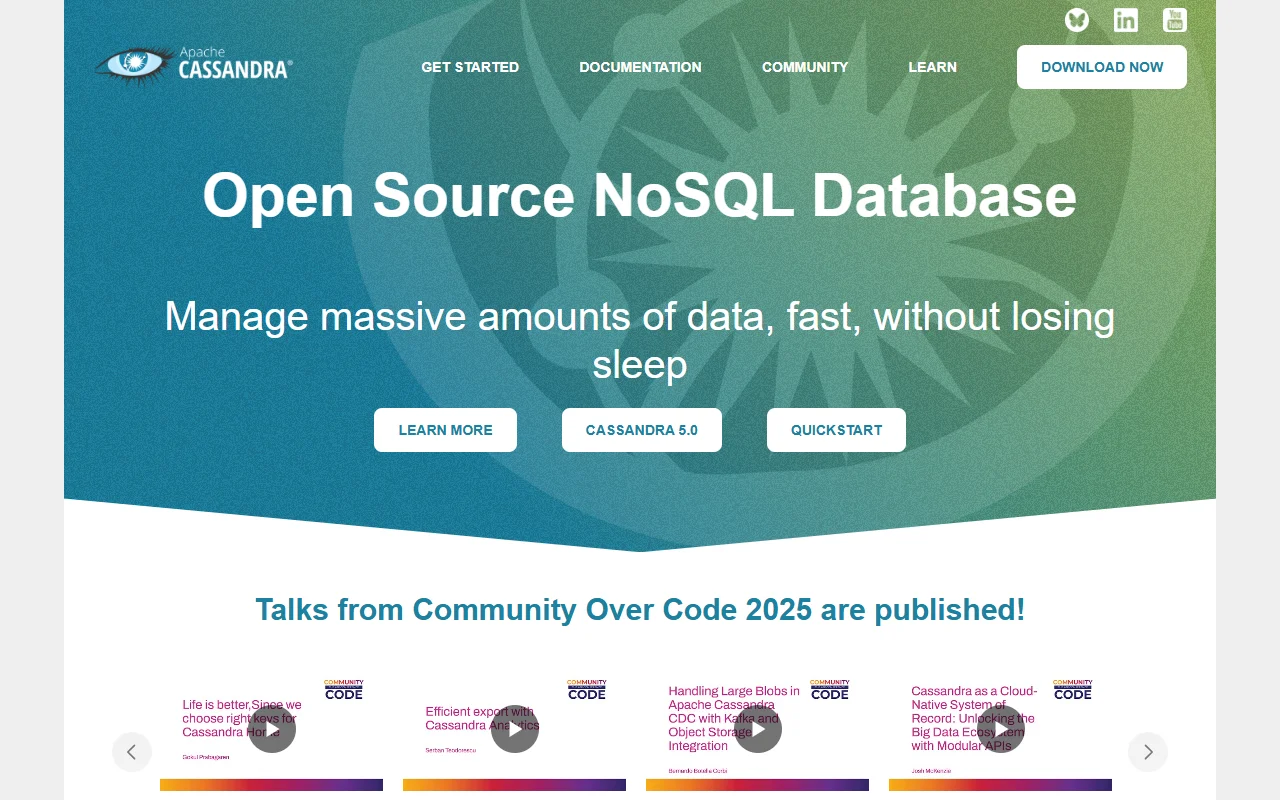
Apache Cassandra is an open source distributed NoSQL database. It is designed to store large volumes of data across many servers while staying available when some of them fail.
What it does
Cassandra spreads data over a cluster of nodes, so capacity grows by adding machines. Data is replicated across nodes, which keeps reads and writes working when one machine goes down. It uses its own query language, CQL, which looks similar to SQL but works with a data model built around the queries you plan to run. Because of that design, tables are usually modelled around access patterns before any data is written.
Key features
- Linear scaling by adding nodes to a cluster
- Replication across nodes and data centers
- CQL query language that looks like SQL
- Storage-attached indexes for secondary queries
- Source code published under the Apache 2.0 license
Who it's for
Teams with very large, write-heavy datasets, platform engineers who need uptime across regions, and developers who are comfortable designing data models around known queries. It is a common choice for event logs, time-based records and user data at scale.
Pricing and good to know
Cassandra is free to download and use under the Apache 2.0 license. Running it costs servers and operations time, and some cloud vendors offer managed versions. Upgrades, repairs and capacity planning need steady attention, so it helps to have people who know the database well before going into production.
Highlights
- Scale a cluster by adding more nodes
- Keep data available when a node fails
- Query data with CQL, a SQL-like language
- Index columns for secondary queries
- Replicate data across several data centers