
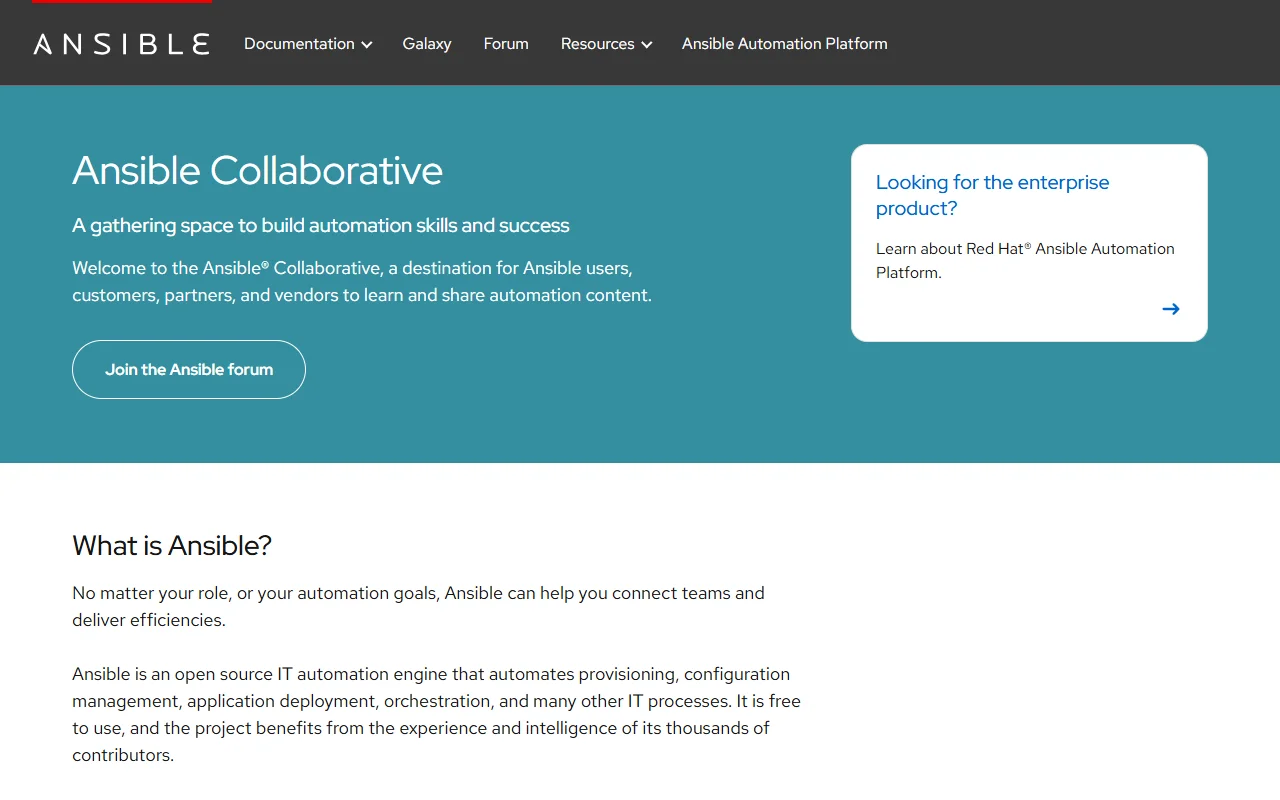
About Ansible
Ansible is an open source IT automation engine for provisioning, configuration and application deployment. It works without installing agents on the machines it manages.
What it does
Ansible describes the desired state of your systems in playbooks written in YAML. It connects to target machines and makes them match that state. Reusable roles and collections, shared through Ansible Galaxy, let teams start from pre-built automation instead of writing every task from scratch.
Key features
- Playbooks written in YAML
- Agentless connection to managed hosts
- Reusable roles and collections
- Inventories for grouping machines
Who it's for
System administrators, DevOps engineers and developers who manage many servers and want repeatable changes. Beginners can start with the official tutorials and interactive labs before writing their own playbooks.
Pricing and good to know
Ansible is free to use and released under the GPL-3.0 licence. Red Hat sells a commercial platform built on the open source project that adds support and enterprise features. The control machine that runs Ansible typically needs Linux or macOS, while managed hosts can be a wider range of systems.
Highlights
- Describe server setup as readable YAML playbooks
- Manage hosts over SSH without installing agents
- Reuse roles and collections from Ansible Galaxy
- Group machines into inventories
- Run the same change across many servers